Engagement in Art Education

Engaging the Modern-Day (Insert Noun Here)

Paying Attention to Students, Spectators and Artists’ Processes in Today’s World.

Evolution is a critical component of survival for both biological and non-biological entities such as viruses, bacterium, animal species, industries, fields, products, and companies. This includes Art Education, especially now and more than ever. We live in an age of digital and technological developments that have afforded us luxuries, more adequate food and water supplies, medical breakthroughs, improved communications and computer programming, and more. Moreover, we have gained indefinite capacities to create and communicate through art with many of these advancements. There are new products on the market that allow students, artists and spectators to experience in different ways. Now, artists are creating artwork with new mediums such Karen Walker (http://karenwalkerfineart.com) with alcohol inks, mix-media art combining like sculpture and paint by Joseph Grazi (http://josephgrazi.com), and utilizing computer programs to build digital illustrations and paintings like Deiv Calviz (http://deivcalviz.com). However, there is a disconnect in engaging many modern-day people and delivering art education in ways that different populaces such as students in art classrooms within public schools and spectators visiting museums and local art events. How can we close these gaps in the age of Information?

The average modern-day student is bombarded with information from many school subjects, advertisement of products in every marketable industry, and videos of violence on social media platforms through constant connectivity. A predominantly popular form, video art, has wired youth diving in head first into digital mediums and sharing their creativity through Youtube, Facebook, Instagram, Snapchat, Twitter and more. One can find many online elementary videos created by a segmented market that is saturated with youths looking for a creative outlet to critique toys, remix mainstream music videos and films, record cosplay action sequences, and discuss whatever their heart desires. However, many of these productions are missing the quality of basic filmmaking strategies that make pieces consistent, cohesive, and interesting through storyboarding for a well-thought narrative, a variety of imagery created through different lenses and lighting, and post-production music and transitions for ambiance. If we, as art educators, delve deeper into the issue of limited skill sets, then we can acknowledge that ever-evolving technology limits students’ attention span to crafting their art because there is something new coming out constantly that competes for their concentration. Thus, students are always running off to the next big thing. This creates a vacuum of necessity for art educators to be very present with their students and create a space for their students to learn more beyond shoot film and share. Duncam (2014) states, “The Do-It-Yourself aesthetic is not necessarily something to celebrate. Today, I teach my undergraduate art education students about framing, angles-of-view, the effect if different lenses and lighting, the use different camera movements, and so on; in short, I teach a basic grammar of movie making.” I agree with Duncan’s methodology in teaching the techniques behind a medium. As art educators it is our responsibility to learn how to embrace the new changes in industry and not only fill in those gaps for ourselves, but for our students as well. Teachers are life-long learners that must reinvent themselves constantly in order to enable and empower our future generations with the life skills to march forward in an uncertain future full of caveatsthat we have not yet even fathomed.

Many contemporary spectators are subjected to the similar issues in art education as present-day students. For example, museums are competing with different markets catering to the consumer-experience such as amusement parks, movie industry and streaming apps. These educational institutions help provide a platform for artists to share their artwork, preserve culture, and cultivate the community through engagement. Artists are incorporating museums in different ways that extend beyond hanging masterpieces on walls. O’Donoghue (2015) discusses several artists who capture spectators interest through experiential-based art practices. The artists, Carsten Höller and Marina Abramovic, created installations that invited participants to be a part of art and presented opportunities to explore themselves, which is what artists do during their own creative process. O’Donoghue (2015) proposes, “Might we say, then, that to focus on experience in art education is to immerse oneself in the qualities of the teaching and learning experience? And, that it is to pay attention to the possibilities, promise, an actualities of one’s encounters and exchanges with others- objects, people, and processes alike.” Spectators became more engaged with art and it is believed to enhance their thinking and beliefs through self-examination.

As an art educator, I can empathize with both modern-day students and understand the evolution of art education in both classrooms and museums. Currently, I am a substitute teacher and a store clerk at the Harn Museum in Gainesville, Florida. However, I remember growing up during the early stages of Informational Ages and diving head first into new technology. In hindsight, I can agree that most of time I had stumbled in learning computers and programs with little instruction due to it was new and there was limited access to technologies. Previous classroom settings may have or have not included a computer in a classroom that may have had thirty to sixty students. Today, I learned most of my computer skills through technical courses during high school and online tutorials. Also, I utilize YouTube to self-teach painting techniques, crocheting, and critiques for art supplies prior to purchasing. I think there are more positive than negative aspects with integrating new technology and contemporary pedagogies in art education such as being able to research information for projects, create artwork through new fine art mediums and computer programs such as Final Cut Pro, Illustrator and Photoshop, and share my vision through websites and social media platforms with other students, artists and spectators. As per museums, I see the behind-the-scene dynamics that keeps the Harn Museum popular and as an influential establishment within the community and art industry. It keeps up-to-date with contemporary exhibits, such as The World to Come, that brings in viewers from all over the country and attracts local people with a different themes hosted through a program called Museum Nights at the Harn. The experiences I gain through working at a museum, being a substitute teacher, attending this graduate program and my upbringing contribute to my evolution as an artist, art educator and spectator. I plan to use my experiences and knowledge to help shape future artists, teach our youth skill sets that will help them in their life journey into the future, and impact our community.

References

Duncum, Paul. (2015). A Journey Toward an Art Education for Wired Youth. National Art Education Association Studies in Art Education: A Journal of Issues and Research, 56(4), 295-306.

O’Donoghue, Dónal.(2015). The Turn to Experience in Contemporary Art: A Potentiality for Thinking Art Education Differently. National Art Education Association Studies in Art Education: A Journal of Issues and Research, 56(2), 103-113.

Storytelling in Visual Effects

“Everyone has a story. And there is something to learn for every experience.” – Oprah Winfrey

Introduction
The fascination with storytelling is as old as the tale of time. It is in human nature to build self-awareness as well as community because that is what bonds us… the innate desire to connect. In that longing to build bridges between each other, our ancestors painted on cave walls, created cuneiform and hieroglyphics to record information and track supplies, spoke myths into life about gods and goddesses to help explained nature, shared parables for moral guidance, developed the first photograph of what was outside a window, pioneered the first film of a horse running, etc.  All to document our experiences, thoughts and feelings.  Is it not the human condition to want to be seen and to see others? If yes, is storytelling not the foundation that drives the Film Industry? If not, then what is it? 

Storytelling is defined by the Oxford Dictionary as the action or activity of telling stories, or a particular story. Can this be broken down further? Absolutely, as storytelling is way more richer than a simple definition. Storytelling is the active action of building worlds, creating characters, presenting problems to find solutions, historical documentation, sharing lullabies and fables…everything in and up to including  a visual record of concepts, places, people and/or things. It seems that storytelling is more complex as a double-edged sword. If that is the case, then words and concepts can be willed like a sword in the sense that it can cut through the collective noise and carve out a space for others to relate with. If storytelling performs as a way to positively express oneself, engage others, and allow space for improvement, then it can be a road map of what we are trying to share and accomplish.

What makes Storytelling and Digital Effects important?
The act of storytelling, regardless of which format, compels us to be creative artists, dreamers, problem-solvers, investigators, inventors, and a dash of entrepreneurs. Well, maybe more than a dash of entrepreneurs because we all know how expensive movie production can be in itself. I would say more like a large crock pot full of investors… and a couple of sugar daddies. Don’t forget sugar mommas for the inclusivity of the politically correct! Needless to say, we have to take it a step back before movie production, we have to know which direction we are going before we can even get there. With that being said, storytelling is similar to a map as it gives us the necessary information on what is being done, where to go, what is needed and what is not. 

Storytelling is limited in the sense it is not tangible until it is written down, we can read the script, and sketch out or create digital storyboards. Personally, I think both go hand in hand and are essential to the creative process as again it is the checklist and roadmap to the vision of a film. However, I think that storyboarding is a bit more vital in the industry as it can be so elaborate that it is the actual movie storyline just in illustration form. As we learned in class about Jurassic Park (1993), the video discussed and documents the digital storyboard for the movie. I found it to be so detailed and amazing that it was basically the movie in a digital drawing format. Essentially, it was so well-thought out that it looked exactly like the filmed version of it. I would like to reference the car and bathroom with the T-rex sequence. It was followed to the T that literally the drawn characters and dinosaurs seemed to be replaced by the actors and digitalized and VFX dinosaurs in the motion picture keyframe by keyframe. We can see how successful that movie turned out in the box office and I believe it contributed to the time and effort of the teams involved with both storytelling and storyboarding  which cascaded down in the effectiveness of production and postproduction teams.

In response to George Lucas’ statement, “The realm of storytelling is more important than that of the visual effects necessary to bring a scene to life.” I believe it is a bit… for the lack of better words and excuse my frankness… hypocritical in the sense that his film, Star Wars (1977), was prolific in the rise of Visual Effects. Yes, the premise of the story was a success in that it led to many spinoffs, prequels and sequels about multiple battles and characters of different storylines. However, it is common knowledge that several studios like United Artists and Universal passed on the script so it makes me wonder if the storytelling aspect was not as strong as it was originally. Think about it… the film was in the preliminary stages and was not in production. Therefore, there would not have been any visual effects produced yet. In a video, The Rise of CGI, Peter Jackson claimed, “In the world of Digital Effects, anything imagined is possible…”. Yes, it absolutely does! Visual Effects allows anyone to generate their dreams, visions and concepts from inside their brain to their hands to the outside world. It allows one to construct scenes that would not otherwise be achievable in the sense that we now can make nebulas, underwater worlds, enhance character features that would be either more time consuming or eat more of the budget up. 

What makes Storytelling or Digital Effects more important?
Now let us discuss the pros and cons for both storytelling and Digital Effects. The pros about storytelling involves providing a baseline for the direction of a film. It gives the producers, directors and everyone involved the who, the why, the what, the when and the where of the overarching theme and plot. The pros for Digital Effects are that it allows limitless creativity and can enhance the storyline in a way that makes an audience more reactive to the film. However, the cons of both storytelling and Digital Effects are rooted in how well written or produced a sequence is made. It can also limit the story in the sense that one’s vision can be so stuck on a specific outcome that it causes other options to not be explored or investigated as a convergent solution to a problem. 

In conclusion, I still stand by my original viewpoint. I wholeheartedly believe that storytelling and Digital Effects work hand in hand with each other. They both bring their own attributes to the table in order to support the overall success of the industry. Each has their own pros and cons, but it does not change the fact that both are necessary tools for the film industry toolkit. 

References
https://www.oed.com/search/dictionary/?scope=Entries&q=storytelling

Curriculum in Teaching Art

What’s Worth or Not Worth Teaching in Art? That is the Question.

Summary
Upon reading the required material for Module 1, I started sensing that the question “What is worth teaching in art?” is just as heavy-loaded as the other hard-to-define question “What is Art?” These answers can easily be influenced by subjective perceptions and lobbyists’ intentions, but the subject is too broad to put in the proverbial box for standardization purposes. However, these articles attempt to reconcile the different viewpoints and solidify an idea that curriculum should prepare students to be critical thinkers through divergent methods of play, open-ended questions, and challenging common knowledge as the only valid truth in order to capture their attention and have them invested into their own education.

The common goals of each author were to empower teachers in creating effective curricula that will engage students to be active participants in their educational journey through K-12, and plant seeds of positive habits through lesson plans that will enable students to cultivate a desire to ask questions and seek answers for themselves in art and other aspects of their lives. Wiggins (2002) discusses the impossible belief that students will have learned everything in their academic tenure in school by describing it as stylish bow, “rather than the TV-view that by the end of a class or school career all the ‘answers’ have been ‘taught’ and tied together in a happy ending (p. 49).” Instead, Wiggins implores instructors to give novices the tools to be successful during their time in school and after graduation by encouraging self-awareness. In this kind of environment, we should prompt students to unveil their thoughts, explore their own boundaries and intrinsic value in their community, and to question everything just like the same experts they are learning from/about. The authors charge teachers with the responsibility to prepare more in-depth modules that go beyond the scope of archaic or trite art education practices that limit the beginning stages of the creative process for pupils before projects are introduced.

Each author supports the idea that art education curriculum should challenge, engage and inspire students to be active participants in their own education. Also, they seem to unanimously agree that critical thinking is the key to academic success, but each article proposes its own approach on how to build an inclusive and engaging lesson plan. Wiggins (2002) and Bolin’s (1996) idea of curriculum planning is influenced by the independence from force-fed information. In comparison, Wiggin refers to Boorstun’s (1985) notion, “Take nobody’s word for it, see for yourself (p.45).” and Bolin spells it very clearly in the title of his article, We Are What We Ask. I found this article to be quite refreshing because it posed those questions educators should ask themselves and of their students. Additionally, I enjoyed the word play Bolin uses to hit home the similar idea of “we are what we eat.” Therefore, the teacher should prepare students to seek out answers for themselves instead of accepting what is put before them like fast food. Gude (2007) takes this a step further introducing her Principle of Possibilities, which are backed up by research from The University of Chicago’s Spiral Workshops and colleagues. She referred to childhood development and psychological research to explain the importance of play and teachers should allows students to make creative messes so they can work through the process. Whereas, Lampert (2013) actually defines what each previous author described. Lampert actually refers to the importance of critical thinkingand conducted a study that focused on the success of inquiry-based curriculums.

Key Points
Wiggins’ (2002) main idea explained why is impossible to teach students everything about art within the span of their academic career. Instead, we should instill in them the hunger to learn more, ask questions, and challenge common knowledge. Therefore, they will have acquired a lifelong skill of seeking out information for themselves and have a better opportunity to be successful in learning and absorbing information. He believes that students should be trained in this way so asking questions is from muscle-memory like an athlete.

Bolin’s (1996) key point focused on utilizing the cliché, “you are what you eat” as a homage to reinforce the idea that we are who we are by asking questions as to why are we here and what is our purpose in life. As it is quite amusing, it is also important to understand that we are a summation of our human experiences while on earth, so it is our responsibility to enhance those chances by getting to know ourselves, inspect our environments, question our existence, and significantly contribute to the global conversation.

Gude’s (2007) article suggests ways to update the curriculum to integrate students’ experiences into art making by being present, creating projects and opportunities for them to express themselves, stimulate a dialogue within the classroom so students can expand their investigation within themselves as a way for teachers to motivate these students into investing into their own learning. She offers very insightful explanations on how to integrate questions and engage students within lesson plans, such as developing organic images from inkblots, wax, and smoke marks, rather than build it around just one finite image or concept (p.8).

Lampert’s (2013) research advises instructors to turn away from direct inquiry that require yes/no answers and implement open-ended questions instead. This supports students in building their endurance for critical thinking in creativity. Like Gude, Lampert gave an in-depth account of how to prepare and build the Inside/Outside boxes. She used a worksheet to help students start the creative process on how they think they are seen as and how they perceive themselves. After, the materials were introduced and the students were given the freedom to express their own self-identities and thoughts.

Personal Reflection
As mentioned in the introduction, I felt these were heavy questions artists should ask themselves as well, let alone teachers and students. The questions proposed within the readings achieved its goal of making me wonder about my thought process in art and art education. I found these articles introduced refreshing ideas on how to create my future lesson plans by using open-ended questions and integrating additional ways that would encompass a concept, principle or element. I literally cracked up laughing when Gude (2007) discussed a module focusing on line because I was about to do exactly what she suggested not to do (p.7). Therefore, this article was perfectly timed by fate. Also, her article made me feel more confident in what I am doing within my classroom. I always remind students that art class is a time to use their other side of their brain, which is a nice break from all the reading, writing, arithmetic and sciences. As part of classroom management, I have been using a game called “Students-versus-Teacher”, in which, as a group, they earn a point for each positive behavior they exhibit. Last week, I taught the elements of art through dialogue and poster board. Then, we watched a Youtube video for additional reinforcement of the lesson. After the short video, we played trivia and the kids were so excited because they got to earn additional points for the Student-versus-Teacher game. The prize can be something as simple as two- minute volleyball or a chance to pick something from the treasure bucket at the end of class. Play is the simplest way to build bridges between people and by incorporating it, these children have brightened up, worked very hard and we bonded. Furthermore, I think play helps students be more inquisitive about everything and will keep their innate sense of wonder. Additionally, I really appreciated Lampert’s ideas for the after-school program and Gude’s examples for lesson plans. Each made me think about ways to expand the lessons in ways to motivate students to participate in class. I feel more prepared and empowered as an educator, and this module really helped me open my eyes to create interactive and engaging lesson plans, ways to enhance the dialogue between administration and art education, as well ways to pivot in my professional development.

 References
Bolin, P. (1996). We are what we ask. Art Education, 49(5), 6-10.

Gude, O. (2007). Principles of Possibility: Considerations for a 21stcentury art & culture curriculum. Art Education, 60(1), 6-17.

Lambert, N. (2013). Inquiry and critical thinking in an elementary art program. Art Education, 66(6), p. 6-17.

Wiggins, G. (1989). The futility of trying to teach everything of importance. Educational Leadership, 47(3), 44-48, 57-59.

History of Art Education

All the Colors of Prang

 “Let us take good care of the colors. Let them enjoy the color, – they will handle it with care, because of their pleasure in it.”– Louis Prang (Prang 1893)

Louis Prang is known as an artist, innovator and successful businessman who profoundly influenced the landscape of art education, the print industry and color theory. Prior to this class and project, I did not know much about Prang and his influences on the modern-day classroom. I think it was because I had not made the mental connection of his name to influences, educational tools and the color wheel. However, the name rand a bell because of the reading in our class and I saw some of his products in an art class I had substituted for recently. The purpose of this Indie Research project is to learn more about Louis Prang’s life, achievements, and influences on modern-day art classes.

Louis Prang was born on March 24,1824 in Prussia, which is modern-day Poland. A majority of his influence in the print industry was attributed to his father, Jonas Louis Prang, who owned a print and textile workshop. Through his apprenticeship, Prang learned both about business and print processes such as dyeing, engraving, and calico printing. He travelled Europe as a journeyman in which he met his first wife, Rosa Gerber. However, due to the German Revolution, Prang fled his homeland to New York and then migrated to Boston.

In Boston, he continued to work in the printing industry and excelled.  He supported himself and his wife by making wood engravings for publishers. He learned lithography from his protégé, Julius Mayer, and together they started Prang & Mayer in 1856. The company focused on producing business cards, announcements, prints of Civil War maps and portraits, albums and collectible business cards of floral arrangements and Christmas cards. His wife influenced many of the designs because of her affinity for flowers. In 1860, Prang bought out Mayer and changed the name to L. Prang & Company. He had offices around the world in London, Boston, Chicago, New York, South America, Australia, and India.

In 1864, Prang and his family travelled back to Europe so he can study different European print processes and recruit artists to relocate for his company. Upon his return to the United States, he began to produce chromolithographs of landscapes. Chromolithography, a technique created in Germany during 1800’s, is a chemical process where an image is applied on stone, zinc or aluminum surfaces. Due to the repulsion properties of grease and water, they were used to block certain areas of the print. Each stone would be prepared with specific colors of ink so the final proof could be repeated for printing multiple copies of an image. The stone would pass through a press thus creating a product that revolutionized commercial printing because it could create more prints unlike metal etchings. Prang utilized this process to create Christmas cards, which resulted in him earning the moniker, “Father of Christmas Cards” due to its’ massive success in both Europe and the United States during the 1870s. Furthermore, Prang began publishing drawing and art textbooks for elementary public schools. The success and growth in business sales and publishing production of educational products led to the creation of a subsidiary enterprise, the Prang Educational Company.

Between 1881 and 1900, Prang experience many changes in business and his personal life. The company had endured a merger, changed its’ name to the Taber- Prang Company and published educational textbooks, tools, journals and printed artwork and articles of contemporary artists and educators. Also, the corporation moved from Boston, Massachusetts to Springfield, Massachusetts. During this time, Prang worked with two prominent art educators, Walter Smith and John S. Clark. Prang published Walter Smith’s textbooks that advocated the South Kensington approach but believed Smith’s works should be curtailed to meet the needs of contemporary art studies. Prang and Smith professionally separated. Smith returned to Europe and Prang continued to edit and publish his works. Prang turned to John S. Clark to work together on the subject of color theory, thus the Prang color system was created. It consists on 12 units of colors organized in different levels that can be crossed with each other to create different colors and are organized in a pattern of a wheel. Primary Colors are blue, yellow, and red. Secondary colors (also know as Intermediary), which are purple, green and orange. Tertiary colors are red-orange, yellow-orange, red-purple, blue-purple, yellow-green, and blue-green). By 1898, his wife, Rosa, passed away and he remarried an art teacher and author associated with the Prang Educational Company, Mary Dana Hicks.

Prior to their marriage, Prang, Hicks and Josephine Locke, a staff member, wrote The Prang Primary Course in Art Education Suggestions for Use of Form Study, Drawing and Color in Relation to Art Education and also in Their Relation to General Education in Primary Schoolsin 1893. The textbook discusses form drawing, activities, materials, and techniques. It consists of 36 chapters with each chapter focusing on lesson plans for each school week for teacher’s to utilize. Each chapter builds off of the previous lesson paying particular attention to drawing forms focused on the sphere, cube, cylinder, ellipsoid, etc., modeling with clay, paper folding, tablet arrangements, and the study of color in nature.  Prang’s encouraged teachers to allow students to be receptive and expressive by asking questions that are thought-provoking such as ”How much can you see of the sphere? Have you ever made a cube? How much can you remember about a cylinder?” Also, Prang’s lesson plans were age appropriate especially in regards to color. He created curriculum that allow students to arrange colored tablets in different arrangements and patterns to understand the relation between colors and to discuss their choices in artwork. The children were encouraged to name the colors, see how many colors they know, group the colors (i.e. warm or cool), and see the difference between different values within a color on a scale. Some of the color exercises consisted of cutting up different colored papers in different shapes and placing them next to each other to give a comparison of how colors can change in relation to space, shape and shadow. For example, Prang discusses shapes of cube and prisms with tones of red, orange, and yellow.

Prang understood the influence of nature and genetics on art education. He encouraged the study of art in nature. However, he acknowledged there is a difference between color in nature and color pigments in art. The spectrum of colors in nature and in art never seem to be quite the same. Despite the discrepancy, Prang encouraged studying nature as an important component to have a well-rounded art education. As per genetics, Prang theorized that each person perceived color differently. His wife, Mary Dana Hicks Prang, conducted studies that confirmed his theory through child studies conducted with students from different ethnicities attending separate schools in unrelated cities and states.  She concluded there were slight differences and attempted to incorporate her findings into the new art education curriculum. At this time, Prang stepped down from managing the company and decided travelling to promote his educational tools was his passion. Unfortunately, Prang passed away from pneumonia during a marketing trip to California in 1909.

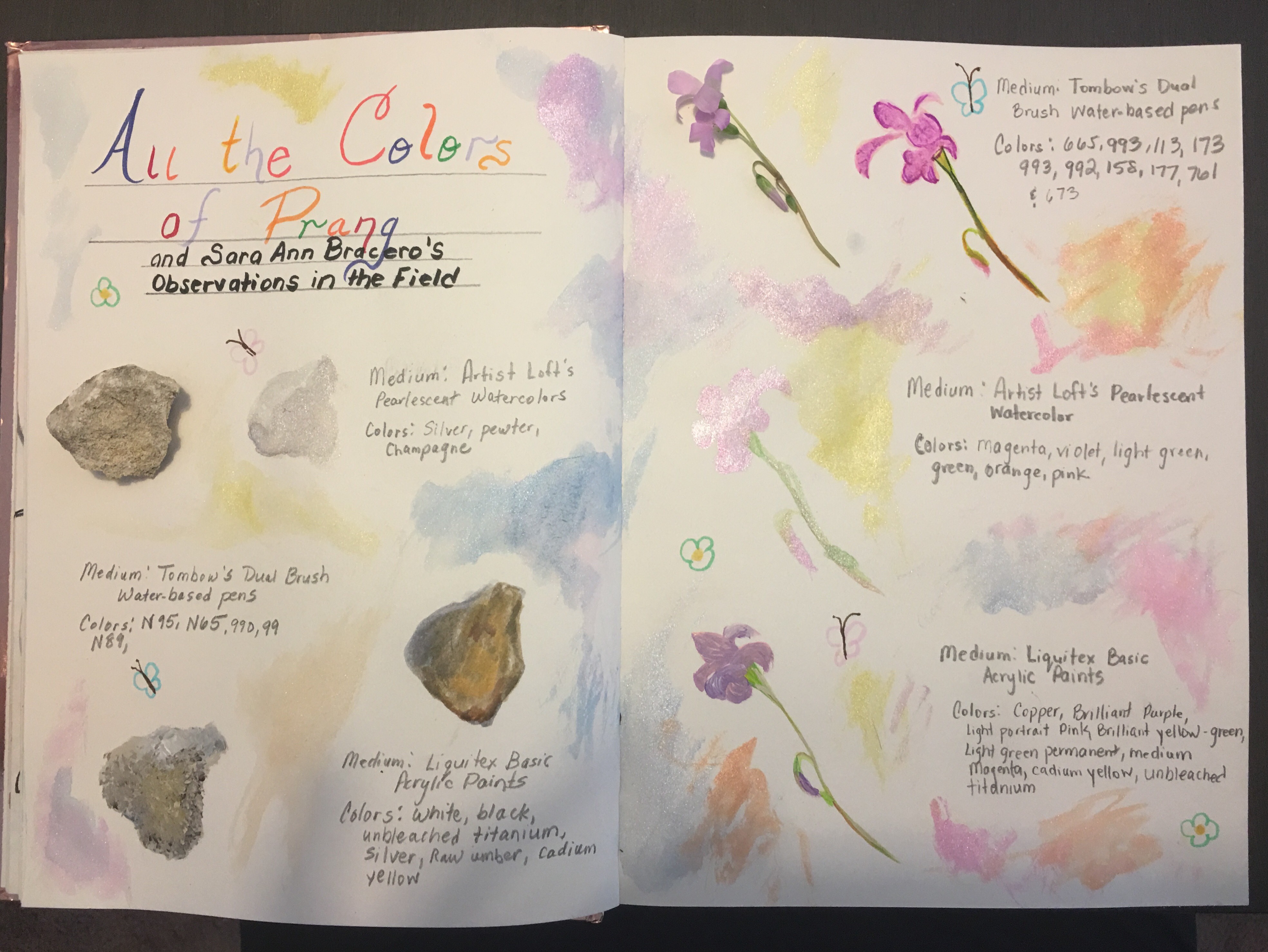
To further help understand Prang’s practices, I decided to base the art project component on studying nature and recreating objects found in through various mediums. I desired to test Prang’s theory on the difference between color in nature and color pigments in art materials.  My hypothesis is that there will be differences depending on the subject and various mediums. Some mediums can emulate real objects with subtle differences due to pigment saturation, pigment binders and techniques. The variables are products available to the artist and level of artist’s mastery of mediums. My son and I went foraging in our back yard to find specimens, which were a rock, small flower, twigs and two contrasting leaves. The materials used are Liquitex basic acrylic paints, Artist’s Loft pearlescent watercolor set and Timbow’s water-based brush pens sets (Primary, Secondary, Landscape, Pastel). The specimenswere placed on the top left corner and each drawing/ painting were sketched to the objects’ left. Please note the real leaves are above the sketches. Also, each drawing/ painting is labeled with which medium and colors were used. The results of this experiment are above.

In conclusion, I do agree with Prang’s theory that colors in nature is different from man-made pigments. However, I concur it also depends on materials available in the market, pigment saturation and binders in each medium, and the level of artists’ mastery of techniques and art supplies. There are more available art supplies today are not the same as the materials Prang and students used in the late 1800s and early 1900s. The supplies used in this experiment were not available during the time and these products are mass-produced for the public. Whereas, many preceding artists made many of their own supplies, which gave them the advantage of creating a color palette that was closer to their needs for a specific artwork. I further believe the object and medium used had an impact on the outcome of the experiment. I found Liquitex basic acrylic paints were more successful in copying the rock and flower specimens. Timbow’s water-based brush pens were productive in reproducing the twigs. Artist’s Loft pearlescent watercolor set recreated the brown leaf as realistic as possible. However, I found it difficult to emulate the green leaf with either medium.

image_6483441-11
image_6483441-12

I have thoroughly enjoyed this project because it helped me not only learn about Louis Prang and his influences in art education. It helped furthered my knowledge in understanding art and my love of colors. I do believe colors are based on perception and it is natural for us as humans to try to understand the world around us so we name everything. I feel as a kindred spirit with Louis Prang because he utilized art as a tool to help each of us understand the information we from the world we live in and in turn express our thoughts to each other through the arts. As an educator, I will utilize his methods, theories and educational tools where appropriate in future classes.

References

Hicks, Mary Dana and Locke, Josephine, The Prang primary course in art education suggestions for use of form study, Drawing and color in relation to art education and also in their relation to general education in primary schools. The Prang Educational Company: 1893. Boston, Massachusetts.

Masten, April F. (2018). Re: New England Historical Society: Louis Prang Invents the Christmas Card in Boston. [Online Forum]. Retrieved from http://www.newenglandhistoricalsociety.com/louis-prang-invents-american-christmas-card-boston/

Prang, Louis, Prang’s Civil War Pictures, The Complete Battle Chromos of Louis Prang. Fordham University Press: 2001. New York, New York.

“Prang’s Chromo: A Journal of Popular Art”, 1868-1870.

Stankiewics, Mary Ann. Roots of Art Education Practice. Art Education in Practice Series. Davis Publications: 2001. Worchester, Massachusetts.

_________________________________________________

Contemporary Issues in Art Education

Creativity and Clichés

Abstract
Art is a sensitive subject in both academic institutions and home fronts because of negative assumptions based on clichés and stereotypes.  These biased ideas create contemporary issues in art education classroom settings and negative dialogues between parents and students over their future.  It is important to dispel these trite and misconstrued concepts by introducing positive examples of professional workers in the art industry, elevating artists as multifaceted creators, and offer ways to become a successful and imaginative professional with several sources of income to support their creative life.

Keywords: clichés, stereotypes, art education, starving, successful, creative, multifaceted

Creativity and Clichés
Clichés are preconceived notions that often color one’s perception, values, expectations, and decisions.  In many instances, these clichés can often lead to a negative dialogue within ourselves about things we know either nothing or little about.  The most common stereotype about creative types is the trite image of the “starving artist”, which portrays art as an unstable way to support oneself instead of celebrating itas a robust resource to earn income.  Moreover, it is treated as a phenomenon that only the select few may witness financial stability and recognition. Unfortunately, these misconstrued beliefs influence academic institutions and families’ ideas about art and art education. Some academic administrators do not see art as a subject worthy exploring and investing additional funds into other than viewing it as a “special” class in the modern K-12 schools.  Many parents discourage their children from becoming artists because of the fear that they will not be able to support themselves.  Students become less engaged and art educators are faced with another obstacle to overcome in the art classroom.  Additionally, these misguided concepts ignore the symbiotic relationship between art and other subjects, particularly business.  Artists and entrepreneurs have common traits of creativity, problem solving, risk-taking, and innovation.  Ironically, these are the same qualities future employers are seeking in the workforce pool. According to Reilly (2018), “a 2016 report by the World Economic Forum predicted that the top three job skills in 2020 will be complex problem-solving, critical thinking and creativity” (p.84). Art requires all three skills from artists. Therefore, it is critical to help other people make positive mental connections to help break these stereotypes.  This paper will focus on dispelling the contemporary issues and clichés by understanding the risks and gains of being an art maker and entrepreneur, exploring ways to encourage students to achieve their goals in leading a creative life, discovering approaches to be a successful artist with viable sources of income flow and redefining what a “traditional” artist looks like.

Mentors and Mentees
There is a long history of artists who have witnessed blights and triumphs in the art industry.  By reviewing creative predecessors, one can learn to circumvent the pitfalls and understand how to emulate prosperous strategies to gain employment and success.  For example, Jean-Honoré Fragonard was an artist who witnessed much success during the Rococo period, but he became poor after refusing to acclimate when Neo-classical styles replaced it.  El Greco was very pompous, and did not have many patrons during his living years.  However, he achieved popularity after his death due to his unique techniques that combined attributes of Mannerism, “Titian’s use of color and Tintoretto’s lighting” (Strickland, 2017, p. 45).  Likewise, Johannes Vermeer did not receive recognition until after his life ended. He suffered from impoverishment due to war and a collapsed Dutch-economy. Another example, Claude Monet exhibited difficulties in balancing his finances due to the exorbitant debts for a lavish lifestyle he led during the earlier phase of his life when much of his work did not sell.  Eventually, he regained his financial bearings when his artwork became popular during the latter part of his life.  These artists struggled or passed away poor due to the inability to adapt to changes in the industry, a bad reputation amongst patrons and art critics, economics and hostilities, and mismanagement of money. These downfalls and risks are realistic financial obstacles anyone can encounter and is not only associated with artists and entrepreneurs. Some instances are uncontrollable and others are manageable.  Thus, one can always reinvent oneself to stay current with trends, cultivate their brand respectably with solid work ethics, and properly manage their assets.

Every industry has its negatives and art is no different.  Nonetheless, there are numerous successful artists in today’s market to reference.  For instance, Thomas Kinkadecreated his empire and secured wealth through marketing strategies, and incorporated technological innovation of mass reproducing his paintings.  He dubbed himself as the “Painter of Light”, trademarked it, built franchises of galleries dedicated to his artwork, licensed out rights to use his imagery, and created a foundation dedicated to charity.  Lisa Solomon, a mixed media artist and photographer, networked with her professors after graduation from The University of California at Berkley to help gain employment at galleries. Also, she acquires revenue from published art books and monographs of her work.  In an interview, she recommends maintaining contact with colleagues and professors, maintaining a solid work ethic, and facing fears to further one’s career (Congdon, 2014, p.24). Olivia Be’Nguyen is a self-taught artist who has amassed a large audience of followers on several social media platforms to promote her distinct style, artwork, and her message of positivity.  She gained recognition from developing massive paintings of musical artists such as Drake, Big Sean and Rick Ross.  Camilla d’Errico is a working professional who earns a living by showcasing in international galleries, teaching classes, selling artwork at major events like Dragoncon and Calgary Expo, and publishing books for artists to learn her techniques or for adults to color.  In today’s world, artists are no longer bound to solely rely on gallery sales to earn a living.  These accomplished art experts enjoy prosperity and recognition through technology, networking, marketing, self-promotion on social media, and generating several streams of income.

Artists and Entrepreneurs
The beauty of choosing to live a creative life is the unexpected surprises, and crafting a living like any other masterpiece.  It takes a high level of willingness to step out on faith, affinity for risk-taking, divergent thinking, mental endurance, and being completely honesty with oneself to go through the process.  Societal norms and expectations can be limiting such like working a monotonous job with the same hours and pay, with little-to-no room for flexibility or advancement. It can be a complete shock to make the change from a nine-to-five shift to a self-made schedule, or switching from a standard direct deposit check to managing invoices and making deposits.  Artists and entrepreneurs are synonymous with daredevils (a healthy stereotype in this case) because they define their own limits, rules, and indicators of success. Cameron (2002) suggests the following:

In order for us to grow as artists, we must be willing to risk. We must try to do something more and larger than what we have done before. We cannot continue indefinitely to replicate the successes of our past. Great careers are characterized by great risks (p. 73).

Therefore, success starts with one’s mindset, which affects the ability to adapt and prepare for any possibility.  Casnocha and Hoffman (2012) describes the mode of operating in “permanent beta” as an influx state of constant testing and adjusting business systems such as rolling out new programs or policies until it is perfected.  This tension keeps a person in a state of readiness, and increases their ability to evolve professionally within a market. An additional tool Casnocha and Hoffman (2012) proposes is a coined-term called ABZ Planning, which defines Plan A as the present job, Plan B are opportunities to maximize by pivoting, and Plan Z is the back-up plan for if and when the business fails (p.58).  Therefore, an entrepreneur must stay two steps ahead of themselves and their competition.

Resources
Artists and entrepreneurs, regardless of their level of expertise, should have a basic understanding of their own identity, and develop skills in scheduling, creating business plans, marketing, logistics and managing venues.  Congdon (2014) provides an all-in-one tool kit as a foundational springboard for starting a career as an artist by delving into the do’s and don’t of the art industry. Like Casnocha and Huffman (2012), Congdon reiterates the importance of mindset, creating an inner mantra of positive affirmations as an artist, and dedicating studio time as a source of deep meditation.  The author’s book demonstrates how to self promote via press kits, social media, email blasts and owning a website domain in the artist’s name.  Congdon introduces several ways to generate revenue through illustrations, licensing (the same tactic employed by Kinkade), printing gicleés and publishing books of one’s artworks, teaching and hosting workshops. Also, she provides tips on pricing, shipping artwork, negotiating contracts for commissions, applying for residencies, and preparing to show in galleries and exhibitions. Congdon provides extensive tips and resources on how to start up an artistic enterprise, however, it is Freeman-Zachery (2007) who helps put a creative spin on drumming up attention from gallery representation and introduces playful segments to stimulate the artist’s creativity. Similar to Congdon (2014), Freeman-Zachery (2007) attributes much success to marketing.  Yet, this Freeman-Zachery incorporates the imaginative and innovative side of business through the eyes of artists.  Freeman- Zachery (2007) interviewed James Michael, a found-object sculptor, who discussed creating distressed mail with older postage stamps to pique gallery owners’ interest into opening the package to view his slides.  Michael said, “This little trick worked like a charm and got my foot in the door with many galleries that might not otherwise have ever agreed to view my slides” (Freeman-Zackery, 2007, p. 130).

Another concern most artists face between creating masterpieces and building a business is pricing their artwork. It is similar to a balancing act on a tight rope between the market, and the value an artist puts on their exerted energy, intellectual property, and physical work for each art piece.  Congdon (2014) and Towse (1996) believe the market is a focal point that influences pricing.  However, Congdon views the concept of pricing from a methodical and ethical standpoint, whereas, Towse’s perspective focuses on the labor and time, economics and legalities. Although the approaches differ, both give a well-rounded foundation for artists to begin with estimating and valuing their work. “Familiarize yourself with what other artists are creating, how their work is priced, and whether it’s selling, and you’ll be better prepared to price your art to sell” (Congdon, 2014, p. 97). Additionally, Congdon advocates for integrity, consistency, and to diversify your products. The quality of materials should be considered because it affects prices and sets the artist apart from other competition. The price of an item should be the same when selling it in multiple commerce platforms so the product is the same price online, in a store or at an art fair booth. Also, consider selling reproductions of authentic artwork along with the original version such as cell phone cases, coffee cups, clothing, journals and gicleés. However, Towse (1996) believes labor and costs should influence the price of products instead of the intrinsic value of an artwork. Often artists neglect to consider the time invested in research, planning, acquiring supplies, the costs for supplies and studio space. He implores artists to track the hours and costs associated with each projects. Furthermore, Towse encourages artists to secure copyrights for their work for the purpose of intellectual property rights and royalties.

Black Sheep of Society
Unwarranted clichés often put labels on people, or categorized them into boxes to make it easier for an individual or a group to make sense about others without having to invest much in. Much of society define artists as black sheep with offbeat personalities, and assumes that in ordered to be blessed with the creative gene artists must be: only dressed in dark or bright colors, freakish and tortured souls, perfectionists or messy, brooding and moody, kooky and eccentric, hippy and bohemian, rich or poor, and the list goes on. However, the reality is art is limitless so why would visionary people be confined by clichés? Creativity is the spark in all of us whether if it is in a grandmother crocheting baby booties, a kindergartner experimenting with finger paint, the economics major in an art studio, an art teacher preparing lesson plans, the stay-at-home-parent who throws ceramic cups while the children are napping, the jock sketching between practices, a daughter using mud to paint on construction paper, the son who builds imaginary worlds out of Legos without instructions, the mechanical engineer creating a prototype for a propulsion engine, and so on. We are all uniquely creative and this gift colors our lives in different hues and shades.

Creative Conclusions
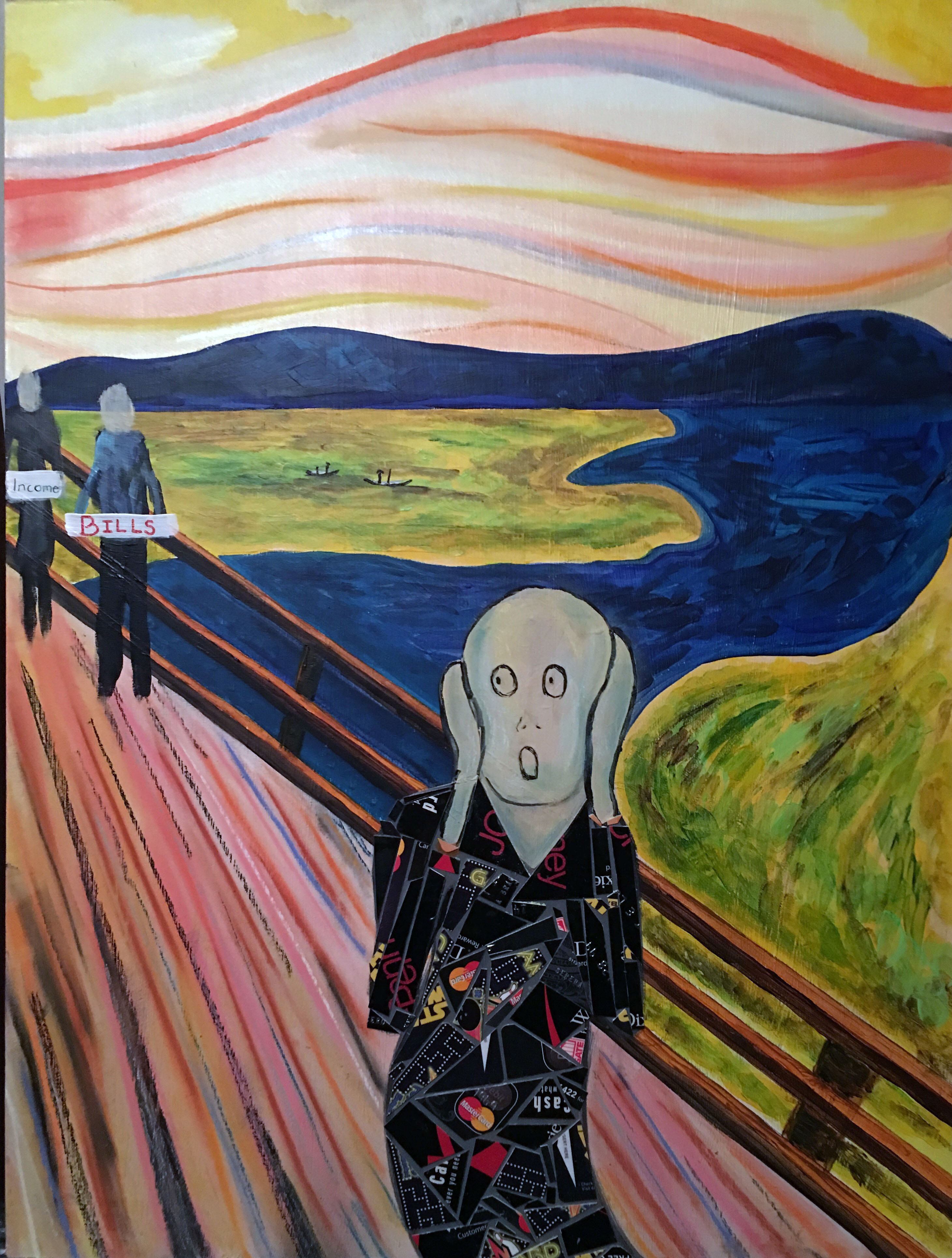
TheModernDayScream

Title: The Modern-Day Scream    Medium: Mixed Media on wood panel   Size: 18×24″

GlowUp

Title: Glow Up    Medium: Mixed Media on wood panel    Size: 36×24″

This independent project really helped broaden my understand of myself as an art educator by considering gaps in art education from my own experiences growing up, dealing with negative stereotypes as an artist, finding my own style through experimenting with mixed media and wood panel, and being an artistic daredevil breaking down my own mental blocks in creativity.  For the artwork component of the assignment, I chose to create a diptych to compare and contrast the negative and positive perspective of lives of the “starving artist” and the “self-actualized” artist.  I decided to heavily experiment with mixed media instead of dabbling with it, so I wanted to really push the envelope.  The innate sense of wonder is one of the many key attributes that are found in all of us artists because it ignites creativity and change. Furthermore, I opted to bring techniques already incorporate with much of my artwork, which includes utilizing modern items that are necessities of everyday life to create textures for the purpose of highlighting contemporary issues in society, accentuating artwork, and the inclusion of hidden meanings.  I enjoy creating new ways for spectators to feel drawn into each piece and evoke the their desire to touch these works because of the realistic and three-dimensional aspect. Additionally, I chose to join found objects with mixed media to capture the freedom and power of creation by combining different techniques, mediums, and styles.  The first portion of the diptych is my rendition of Munch’s The Scream(1893).  It is a demonstrative piece influenced by the German Expressionism style and denotes isolation, apprehension and stress.  I selected this artwork as a point of reference because it is so emotionally charged with similar feelings that anyone can feel when faced with present-day matters such as consumerism, the rising cost-of-living, low-paying jobs, finding alternative ways to generate income or relying on debts in order to make ends meet.  My artwork, The Modern-Day Scream, implies the idea of the “starving artist” because the subject is clothed in pieces of cut up credit cards, and is worried about the two secondary people in the distance. These two individuals hold signs stating income and bills.  The “income” board is smaller to represent the shortage in pay while the “bills” poster is larger to show the disparity between the two.  This piece embodies struggles anyone can relate to in the face of monetary issues, numerous debts and feeling anxious over trying to survive in a society where it now requires two people to work in order to support their family.  The second part of the diptych focuses on what I personally perceive to be success. The artwork focuses on what the artist personally perceives as her success in spite of family members and others being unsupportive, and the negative stereotypes of the trite and old notion of the “starving artist” she heard as she grew up. She dispels this idea by believing in herself and focusing on her purpose on earth, which is to make it prettier, colorful, and a safer place for all to enjoy. The theme reinforces living authentically and unapologetically raw through empowerment, connection with the world, and channeling positive energy energy through the delicate balance of fragility and strength. She opens up her colorful soul by sharing her inner world and heart with the outside world through understanding, nurturing and growth. Repurposing miniature coffee creamer cups highlights global issues and implies the importance of upcycling materials to reduce waste in our lives. The beads around the sunflower represent the seeds of creativity spreading throughout the world. The incorporation of different materials for texture embraces the many disciplines of art, and demonstrates the multifaceted lives of all artists. Art is limitless and creativity is the spark in all of us whether if it is a grandmother who crochets baby booties, a kindergartner experimenting with finger paint, the college student in the studio, an art teacher preparing curricula, the stay-at-home-parent who throws ceramic cups while the children are napping, the jock who sketches between practices… we are all lit up by art.

The premise of the paper tackles different stereotypes, provides context and tips to help build a strong business foundation for artists, allayed negative clichés to make a better understanding of how diverse artists are, and proposed ideas to build an art entrepreneurship educational program. Personally, I would like to work with The University of Florida, Warrington College of Business and College of the Arts, to build an Art Entrepreneurship Art Education [AEAE or (AE)2] curriculum for integration into high school art classes to help students be fearless in pursuing their dreams of being artists, help create a larger landscape of creative prosperity for all artists, and improve opportunities for leadership in the arts.  The curriculum can be tested in advanced placement art classes or magnet schools to collect data on the psychological aspects of purpose-driven artists, whether if the respondents feel supported in their pursuits, initial expectations of what an art entrepreneur means to the participants, and an exit interview to see if the expectations changed.  My idea of an art entrepreneurship program for high schools would focus on teaching students the importance of dedication to studio time, accountability for producing high quality artwork, entrepreneurship, marketing and leadership.  At the end of the year, the program would culminate with a scholastic art fair targeting faculty, fellow students, parents, and local community.  Each student would be responsible for the following:

  • produce a minimum of 15-20 pieces for retail
  • create a business plan including a marketing segment dedicated to logo and business card design, fliers, social media management and a mock radio spot/newspaper ad
  • booth design and execution
  • journal/ sketchbook submittal to document the experience

Along with gaining experience and earning credit towards graduation, I think this would be an amazing opportunity to show students, administrators, and parents the possibilities and importance of an art education. This experience would help students interested in pursuing a college degree stand apart from other applicants.  Furthermore, the conducted research can garner support for further funding of the arts, and prepare budding artists to be successful dignitaries in the art industry.

References
D’Errico, C. (2019). Camilla d’Errico. Retrieved from http://www.camilladerrico.com

Cameron, J. (2002). The artist’s way: A spiritual path to higher creativity. New York, New York: Penguin Putnam, Inc.

Congdon, L. (2014). Art Inc. The essential guide of building your career as an artist. San Francisco, California: Chronicle Books LLC.

Freeman- Zachery, R. (2007). Living the creative life: Ideas and Inspiration from working artists. Cincinatti, Ohio: North Lights Books.

Grant, D. (2002). How to grow as an artist. New York, New York: Allworth Press.

Casnocha, B. & Hoffman, R. (2012). The start-up of you. New York, New York: Crown Publishing Group.

Kinkade, T. (2019). Thomas Kinkade Studios. Retrieved from https://thomaskinkade.com

Munch, E. (2017), The Scream [Oil, tempera, pastel and crayon on cardboard]. National               Gallery, Oslo, Norway. Strickland, C., The annotated Mona Lisa: A crash course in art history from prehistoric to the present. (p.123) Kansas City, Missouri: Andrews McMeel Publishing. (1893).

Reilly, K. (2018, August 3). When schools get creative. Time, 87, 82-87.

Strickland, C. (2017). The annotated Mona Lisa: A crash course in art history from prehistoric to the present. Kansas City, Missouri: Andrews McMeel Publishing.

Solomon. L. (2019). Lisa Solomon. Retrieved from http://www.lisasolomon.com

Towse, R. (1996). Market value and artists’ earnings. In A. Klamer (Eds.), The value of culture: On the relationship between economics an arts. Amsterdam, Netherlands: University Press, pp. 96-107.

Vidot, J. & Be’Nguyen, O. (2016). Fiyabomb. Retrieved from http://www.fiyabomb.com

Copyright © 2010-2025. The Art of Sara Ann Bracero, LLC. All Rights Reserved.